

Buying a home is one of the biggest financial decisions you’ll ever make, and being fully prepared can save you time, stress, and money. In 2025, the housing market continues to evolve with shifting mortgage rates, new loan programs, and updated lending requirements. Whether you’re just starting to think about homeownership or you’re ready to start house hunting, knowing exactly what steps to take can put you in the best position to buy with confidence.
This guide walks you through everything you need to do to prepare for buying a house, from checking your credit to making an offer. Following these steps will streamline your home-buying process and help to avoid any costly mistakes.
How to Prepare If You’re in the Early Stages
If you’re thinking about buying a home but aren’t quite ready to start house hunting, these early steps can help you build a strong financial foundation.
Why Is Your Credit Score Important When Buying a Home?
Your credit score is one of the most important factors for lenders to consider when approving your mortgage. A higher score can lead to better loan terms and lower interest rates, which can save you thousands of dollars over the life of your mortgage.
Steps to Improve Your Credit in 2025:
- Check your credit report for errors and dispute any inaccuracies.
- You can get one free credit report per bureau per year from AnnualCreditReport.com. This does not give you a score, but it is the most accurate.
- You can also register for a free account with Experian to monitor the actual score. However, mortgage credit scores are different than those on your credit card or Experian apps.
- Pay down credit card balances to reduce your credit utilization ratio (percentage of debt owed to your total credit limit).
- Keep in mind that paying down your balances prior to getting your credit pulled can cause a significant swing in your credit score. Your monthly balances should be kept under 30% of the credit limit, but ideally under 10%.
- Make all payments on time to maintain a strong payment history.
- Avoid opening new credit accounts or closing existing accounts before applying for a mortgage.
- New accounts may take up to 6 payments to positive affect your credit, and they can hurt your score in the meantime.
- Closing an existing account can remove a positive tradeline that helps your credit score, and it can reduce your total available credit, increasing your debt utilization ratio.
What Is a Good Debt-to-Income Ratio to Buy a House?
Lenders look at your debt-to-income ratio (DTI) to determine how much you can afford to borrow. This ratio is calculated using your pre-tax, qualifying monthly income, housing expenses, revolving and installment debt, and student loan payments. Generally, a DTI of 43% or lower is recommended for a comfortable budget. Depending on the scenario, some borrowers can qualify for a DTI of 50% on a conventional loan, and 57% on an FHA loan. A mortgage professional can help you explore the loan options available to you.
How Much Do You Need for a Down Payment?
The amount you need for a down payment depends on the loan program you choose. In 2025, many buyers still believe they need 20%, but that’s not always the case.
Common Down Payment Requirements:
- Conventional loans – As low as 3%
- FHA loans – 3.5% (if your credit score is 580+)
- VA loans – 0% (for eligible military members)
- USDA loans – 0% (for qualifying rural areas)
To make homeownership more accessible, some state and local programs offer down payment assistance (DPA) for first-time homebuyers. TruPath Home Loans has several DPA programs available to eligible borrowers. You may also check HUD’s list of local home buying assistance programs to see what’s available in your area.
To save for a down payment, determine the maximum monthly mortgage payment you’re comfortable with. Then, calculate the difference between that amount and your current rent or house payment. Set aside the difference in a dedicated savings account. This strategy not only accelerates your savings but also helps you adjust to a potentially higher monthly payment, making homeownership more manageable.
How to Determine Your Home Buying Budget
Before you start looking at homes, you need to figure out how much you can afford. This includes your mortgage payment, mortgage insurance, property taxes, homeowner’s insurance, homeowner’s associations, and maintenance costs.
Budgeting Tips for 2025:
- Consider rising home prices and interest rates when setting your budget.
- Use a mortgage calculator to estimate your monthly payment. (Try this mortgage calculator.)
How to Prepare When You’re Ready to Start House Hunting
Once you’ve laid the groundwork with your credit, savings, and budget, it’s time to take the next steps toward buying a home. This stage involves researching loan options, securing pre-approval, and assembling the right team to help you navigate the process.
What Are the Best Loan Programs for First-Time Buyers?
Choosing the right loan program is crucial to getting the best mortgage for your financial situation. In 2025, there are several loan options designed to help first-time homebuyers.
Common Loan Programs:
- Conventional Loans – Require as little as 3% down, but may require private mortgage insurance (PMI) if you put down less than 20%.
- Conventional loans are recommended if you have a high credit score, or you have a large down payment.
- FHA Loans – Backed by the government, requiring a 3.5% down payment with a credit score of 580 or higher, or 10% down payment with a credit score under 580. Monthly mortgage insurance is required and added to your mortgage payment. There is also an Upfront Mortgage Insurance Premium (UFMIP) which is normally financed into your loan amount.
- FHA loans are recommended for those with lower credit and/or lower down payments.
- VA Loans – No down payment required for eligible military service members, veterans, and their families.
- VA loans are one of the most powerful loan programs available. They should be used in the majority of scenarios. However, if the veteran is not exempt from the VA Funding Fee and has a large down payment, it is worth comparing a conventional loan.
- USDA Loans – 0% down for buyers purchasing in rural and suburban areas who meet income requirements.
- USDA loans should be looked at any time someone is purchasing in a rural area with a lower down payment. However, they have stricter requirements and are harder to qualify for.
Many states also offer first-time homebuyer programs with lower interest rates, down payment assistance, and closing cost help. TruPath Home Loans has several DPA programs available to eligible borrowers. You may also check HUD’s list of local home buying assistance programs to see what’s available in your area.
What’s the Difference Between Pre-Qualification and Pre-Approval?
Before you start touring homes, getting pre-approved for a mortgage can give you a competitive edge in the 2025 housing market.
- Pre-qualification – A quick estimate of what you might qualify for based on self-reported financial information.
- Pre-approval – A stronger commitment from a lender, where your credit, income, and assets are verified.
- Closing Guarantee* – TruPath Home Loans underwrites your loan upfront and issues an On-Time Closing Guarantee of up to $10,000. This means your offers are effectively as good as cash.
Why Pre-Approval Matters:
✅ Shows sellers you’re a serious buyer
✅ Helps you set a clear home-buying budget
✅ Speeds up the loan process once you make an offer
How Do You Choose the Right Real Estate Agent?
Your real estate agent plays a key role in helping you find the right home, negotiate offers, and navigate the buying process.
Tips for Choosing a Great Agent in 2025:
- Look for experience with first-time buyers and knowledge of the local market.
- Check online reviews and testimonials before making a decision.
- Ask about their availability – the best agents are responsive and proactive.
- Make sure they understand your budget and home-buying goals.
If you don’t know where to start, ask for referrals from friends, family, or your lender. Many lenders have a network of trusted real estate professionals.
What Is an Earnest Money Deposit and How Much Should You Expect to Pay?
When you find the perfect home and make an offer, you’ll typically need to provide an earnest money deposit (EMD) to show sellers you’re serious.
How Much Should You Expect to Pay?
- Earnest money deposits are usually 0.5% to 3% of the home’s purchase price.
- In competitive markets, buyers may offer a higher EMD to stand out.
- The deposit is credited toward your closing costs or down payment once the deal goes through.
💡 Pro Tip:
Earnest money is refundable in most cases, such as if the home inspection uncovers major issues, the appraisal comes in below the purchase price, or if financing falls through (depending on your contract’s contingencies). A good lender or Real Estate agent can help you understand when your money is at risk.
Other Things to Know When Preparing to Buy a House
Buying a home is more than just getting a mortgage and finding the right property. There are several important factors that buyers often overlook—but knowing about them in advance can help you avoid surprises during the process.
Why a Home Inspection Is Essential Before Buying?
A home inspection is one of the most important steps in the home-buying process. Even if a house looks perfect, there could be hidden issues that could cost thousands of dollars to fix.
What Does a Home Inspection Cover?
- Structural components – Foundation, roof, and walls
- Major systems – HVAC, plumbing, and electrical
- Potential hazards – Mold, radon, and pest infestations
💡 Pro Tip:
Always hire a licensed and experienced home inspector. If possible, attend the inspection so you can ask questions in real time.
If the inspection uncovers major issues, you may be able to negotiate repairs or ask for a credit from the seller. In some cases, you might decide to walk away if the problems are too costly to fix.
Comparing Loan Offers Could Save You Thousands
Many homebuyers assume that all mortgage lenders offer similar rates and terms—but that’s not the case. Comparing loan offers could lead to substantial savings and better loan terms. We recommend getting at least a second opinion with a mortgage broker. A recent study showed consumers that work with a mortgage broker save an average of $10,622.
Why It’s Important to Compare Lenders:
- A 0.5% lower interest rate could save you thousands over the life of your loan.
- Some lenders offer lower fees, which can reduce your closing costs.
- Certain lenders may have special first-time buyer programs with better terms.
Steps to Compare Loan Offers in 2025:
- Get Loan Estimates from 2-3 different lenders.
- Some lenders are very good at hiding fees and making their fees seem cheaper than they really are. It’s worth asking someone that reviews mortgage quotes every day to help you compare numbers apples to apples.
- A good mortgage broker will shop 10-20 competitively priced lenders for you, and they can help you compare your best options.
- Compare interest rates, APRs, and lender fees side by side.
- Ask about rate lock options to secure a good rate while you shop for a home.
💡 Pro Tip:
The Consumer Financial Protection Bureau (CFPB) offers a mortgage comparison tool to help buyers evaluate loan offers.
Do You Have to Pay Mortgage Insurance?
Mortgage insurance is an added cost that many first-time homebuyers don’t anticipate. It’s insurance that allows buyers to put less than 20% down on a home because it protects the lender in case of default.
Types of Mortgage Insurance:
- Private Mortgage Insurance (PMI) – Required for conventional loans with less than 20% down. The amount is based on down payment, credit score, debt-to-income ratio, and the number of borrowers on the loan.
- FHA Mortgage Insurance Premium (MIP) – Required for all FHA loans, regardless of down payment amount. The amount can fluctuate slightly based on down payment and loan term, but it is the same across all credit scores. There is an upfront amount of 1.75% that is financed into the loan as well.
- VA Funding Fee – There is no monthly mortgage insurance, but there is a one-time funding fee for VA loans, which is normally financed into the loan. This helps the VA fund the VA Home Loan Program.
💡 How to Avoid Mortgage Insurance:
Put at least 20% down on a conventional loan.
Choose a VA loan (if eligible) since they don’t require PMI.
Look into lender-paid mortgage insurance (LPMI) options but be aware of higher interest rates.
When Can You Remove PMI?
If you have a conventional loan with PMI, you can request cancellation once you reach 20% equity in your home. Lenders are required to automatically remove PMI when your equity reaches 22%.
How to Prepare to Buy a House FAQ
When preparing to buy a home, many first-time buyers have common questions about the process. Here are some of the most frequently asked questions to help you navigate your home-buying journey with confidence.
How Long Does It Take to Buy a House?
The home-buying process can take anywhere from 30 to 90 days, depending on market conditions, loan approval times, and how quickly you find a home. Here’s a general timeline:
- Getting pre-approved – 1 to 3 days
- House hunting – A few weeks to several months (depends on inventory and your preferences)
- Making an offer and negotiating – 1 to 2 weeks
- Home inspection & appraisal – 1 to 2 weeks
- Loan underwriting & closing – 1 to 4 weeks
💡 Pro Tip:
If you’re in a competitive market, getting pre-approved before house hunting can help speed up the process and make your offers more attractive to sellers.
With TruPath Home Loans, the loan underwriting process is often much faster than these industry standards. Most loans can be completed in 2-3 weeks.
What Credit Score Do You Need to Buy a Home in 2025?
Different loan programs have different credit score requirements. Here’s a general guide:
- Conventional loans – 620+ (with a larger down payment) or 700+ (for smaller down payment)
- FHA loans – 580+ (with 3.5% down) or 500+ (with 10% down)
- VA loans – No official minimum, but most lenders prefer 580-620
- USDA loans – 580+
If your credit score is below these thresholds, focus on improving it before applying for a mortgage by:
✔ Paying bills on time
✔ Lowering credit card balances
✔ Avoiding new debt
What Are the Hidden Costs of Buying a Home?
Many buyers focus on the down payment, but there are other costs to consider:
- Closing costs – Typically 1% to 4% of the purchase price depending on area
- Homeowners insurance – Can vary based on location and home value
- Property taxes – Varies by state and county
- HOA fees – If you buy in a community with a homeowner’s association – some associations will also charge a reinvestment/transfer fee
- Moving costs – Hiring movers, rental trucks, or storage fees
💡 Pro Tip:
Some first-time homebuyer programs offer assistance with closing costs—check with your lender to see if you qualify.
When Is the Best Time to Buy a Home?
While you can buy a home any time of year, certain seasons may be better for deals or inventory:
- Spring & Summer – More inventory, but higher prices and competition.
- Fall & Winter – Fewer buyers, meaning better negotiation power, but fewer listings.
📌 2025 Market Watch:
With fluctuating interest rates, the best time to buy depends on your financial readiness rather than seasonal trends.
Can You Buy a House with No Money Down?
Yes! There are loan programs that allow 0% down payment:
- VA loans – For eligible military members, veterans, and spouses.
- USDA loans – For homes in qualifying rural and suburban areas.
- Down Payment Assistance (DPA) programs – Some states and cities offer grants or forgivable loans.
💡 Pro Tip:
Even with a 0% down payment, you may still need money for closing costs, home inspections, and moving expenses.
The Home Buying Process Moves Fast, So Being Prepared Is Key
In 2025, the housing market remains competitive, making preparation more important than ever. With mortgage rates fluctuating and home inventory varying by location, buyers who are well-prepared will have the best chance of securing their dream home.
By taking the right steps—checking your credit, saving for a down payment, getting pre-approved, and working with a trusted real estate agent—you’ll position yourself as a strong buyer.
Key Takeaways for First-Time Homebuyers in 2025:
✅ Start early – Improving your credit, saving money, and researching loan options takes time.
✅ Get pre-approved – This helps you shop with confidence and makes your offers more competitive.
✅ Work with professionals – A knowledgeable loan officer and real estate agent can make the process smoother.
✅ Be ready to move fast – Homes in desirable areas often sell quickly, so be prepared to act when you find the right one.
With the right preparation, buying a home doesn’t have to be overwhelming. Stay informed, work with experts, and take it one step at a time!
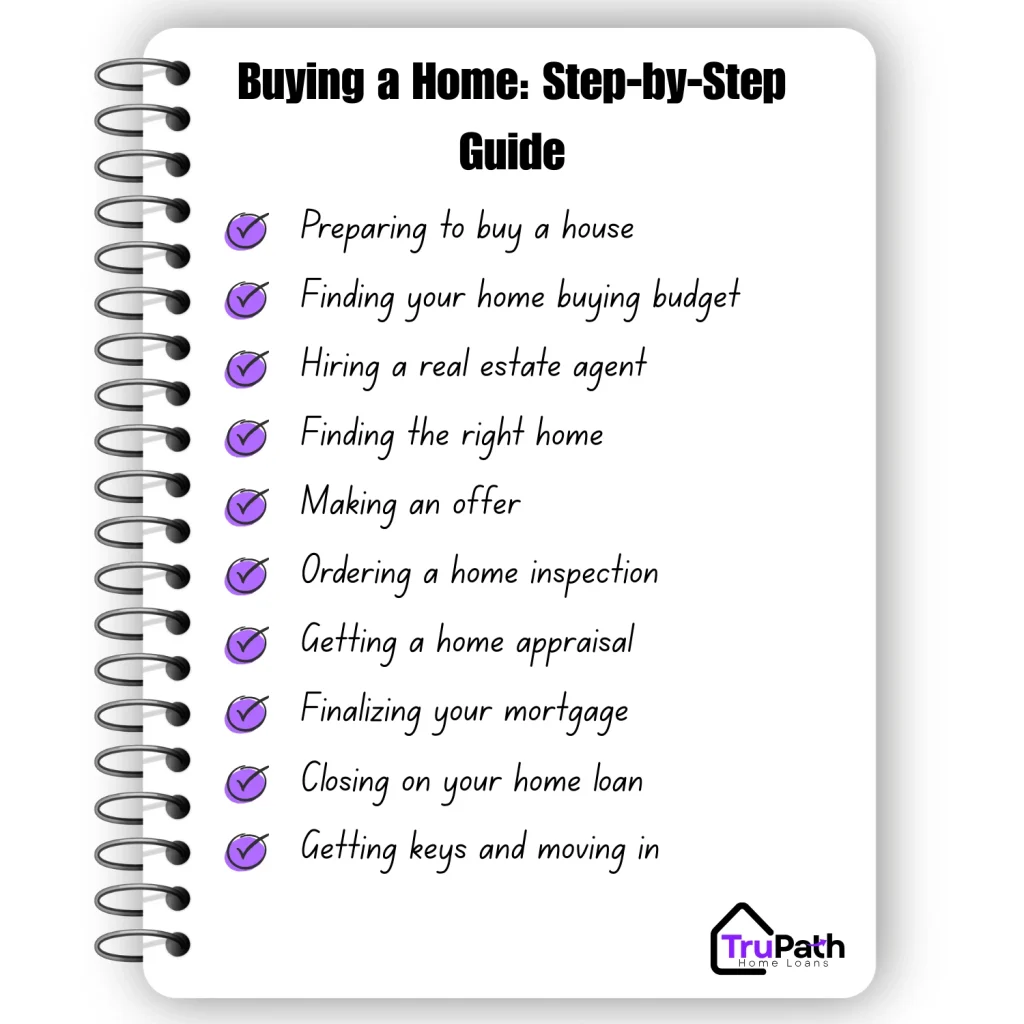
Buying a Home – Step-by-Step Guide
Buying a home is one of the biggest financial decisions you’ll ever make. Whether you’re a first-time homebuyer or an experienced buyer, following a clear step-by-step process can help you stay on track.
Preparing to Buy a House
Before you start house hunting, make sure your finances are in order.
✔ Check your credit score – Aim for 740 for conventional loans, 660 for FHA (though you can get approved with lower scores).
✔ Lower your debt-to-income (DTI) ratio – Ideally, keep it below 45-50%.
✔ Save for a down payment – A larger down payment means lower monthly payments.
✔ Create a realistic budget – Factor in mortgage payments, taxes, insurance, and maintenance costs.
Finding Your Home Buying Budget
Your budget isn’t just about the purchase price—it includes closing costs, taxes, and future expenses. While these aren’t a requirement when it comes to your home loan, they should be kept in mind for future financial planning.
💡 Pro Tip:
Online mortgage calculators are helpful to estimate monthly payments based on different home prices and loan terms. However, some of these calculators can be inaccurate, and it’s worth reaching out to a loan officer even if you aren’t quite home buying ready.
Hiring a Real Estate Agent
A good agent will help you find homes, negotiate offers, and navigate the closing process.
✔ Look for an agent with experience in your target area.
✔ Check online reviews and references.
✔ Ask about their availability and communication style.
Finding the Right Home
Once you’ve set a budget and found an agent, it’s time to start your home search.
🏡 Consider these factors:
- Location – Commute, schools, crime rates, and neighborhood amenities.
- Home size & features – Number of bedrooms, bathrooms, layout, and storage space.
- Condition – Move-in ready or fixer-upper? Inspections will help determine this.
Making an Offer
When you find the right home, you’ll submit an offer with your agent’s help.
📌 What’s included in an offer?
- The purchase price you’re willing to pay.
- Contingencies (home inspection, appraisal, financing).
- A timeline for closing.
Ordering a Home Inspection
A home inspection helps uncover any hidden issues before closing.
✅ Inspect major components – Roof, plumbing, electrical, HVAC.
✅ Request repairs or negotiate credits if issues arise.
✅ Decide if you’ll move forward with the purchase based on inspection results.
Getting a Home Appraisal
The lender requires an appraisal to confirm the home’s value, and it’s a good idea for you to ensure you’re paying a fair price for the home.
💡 Why it matters:
Finalizing Your Mortgage
After your offer is accepted, your lender will finalize the mortgage approval.
📌 Loan underwriting process:
- The lender reviews your income, assets, and debts.
- An appraisal ensures the home’s value matches the loan amount.
- The lender issues a clear-to-close once everything checks out.
Closing on Your Home Loan
Closing is the final step where you officially take ownership of the home.
🔑 What happens at closing?
- You’ll review and sign final documents, including the mortgage agreement.
- Pay closing costs (typically 1% to 4% of the home price).
- The lender disburses funds, and the home is officially yours.
Getting Keys and Moving In
Once everything is finalized, you’ll receive your keys and can move into your new home!
🏡 Final checklist before moving in:
✔ Set up utilities and internet.
✔ Update your address with banks, employers, and subscriptions.
✔ Change the locks for security.
🎉 Congratulations! You’re now a homeowner.
DISCLAIMER:
Down Payment percentages are listed for educational purposes only, and not to be mistaken for an advertisement. Not all applicants will qualify. Reach out to a TruPath Home Loans loan officer for personalized loan programs and information for your situation. Not all borrowers will qualify for the Closing Guarantee. Reach out to a TruPath Home Loans loan officer for details.